


Data loss prevention outsourcing isn’t about giving up control, it’s about gaining expertise. We’ve seen companies struggle for years with understaffed security teams trying to build DLP from scratch, only to realize they’re fighting a battle that requires specialized weapons.
The truth is, managed DLP solutions provide access to advanced tools and 24/7 monitoring that most internal teams simply can’t match. You get enterprise-grade protection without the enterprise-sized budget.
Keep reading to understand how this approach can secure your data while letting you focus on what you do best.
Key Takeaways
- Access to specialized security expertise and cutting-edge tools
- Significant cost savings compared to building in-house capabilities
- Scalable protection that grows with your business needs
The Real Cost of Going It Alone
Building an in-house DLP program sounds like the safer, smarter route. You picture full control, your own rules, your own tools, your own people. On paper, it looks clean.
In practice, it rarely stays that way.
We’ve seen teams sign six-figure contracts for DLP software licenses, only to realize they don’t have the people who can actually make the system work. The platform sits there, powerful but mostly silent, because no one has the time or expertise to tune it.
Understanding the importance of measuring ROI in your security operations can reveal why many struggle to justify the internal investment needed to keep these programs effective.
Where the Money Actually Goes
Here’s where the costs start to stack up:
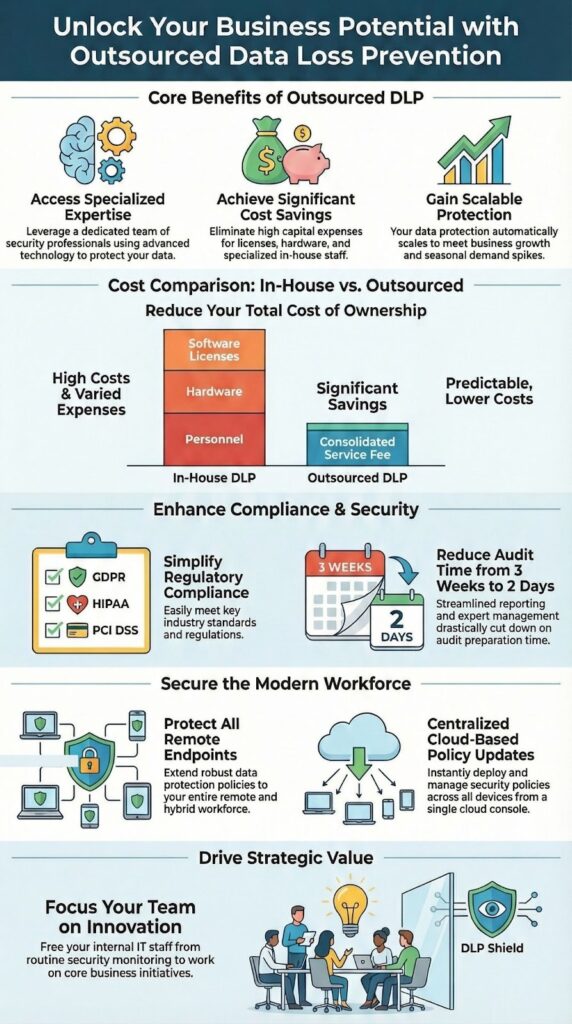
- Licenses: Enterprise-grade DLP tools aren’t cheap, especially at scale.
- Hardware: Servers, storage, and network capacity for full data monitoring can push even strong IT budgets to the edge.
- People: DLP specialists don’t just “help out” on the side, this is their whole job.
One financial services client ran the numbers and realized they’d need:
- 1 lead DLP engineer to design and maintain the system
- 2 full-time analysts to review alerts and refine rules
Three full-time roles. Just to keep the coverage they wanted from falling behind.
The Staffing Squeeze
Finding people who actually know DLP is its own project.
You’re not just hiring any security generalist. You’re looking for:
- Experience with specific DLP platforms
- Understanding of how data moves across your environment
- Ability to write and tune policies without drowning users in noise
Those skills sit in a small, expensive talent pool. Salaries are high, turnover is real, and every vacancy means alerts pile up or policies go stale.
The Hidden Maintenance Burden
Even after you get the tools and the people, the work doesn’t stop. A DLP program isn’t “set it and forget it.” It’s more like a living system that needs constant care.
The ongoing load usually includes:
- Software updates and patching – keeping agents, appliances, and consoles aligned
- Policy tuning – adjusting rules when they’re too strict, too loose, or just outdated
- False positive management – sorting through alerts that turn out to be harmless, over and over
Every one of those tasks pulls hours away from other security and business projects. When teams can’t keep up, they start cutting corners: fewer policies, looser coverage, longer alert backlogs.
And that’s how a very expensive DLP platform slowly turns into a quiet box in the rack, running old rules against new risks, while everyone tells themselves they “have DLP” because the contract is still active.
| Cost Area | In-House DLP Program | Outsourced DLP Service |
| Software Licenses | High upfront enterprise licensing costs | Included in service subscription |
| Infrastructure | Servers, storage, network capacity required | Cloud-based, no customer-owned hardware |
| Staffing | DLP engineers and full-time analysts required | Specialized DLP experts included |
| Monitoring Coverage | Limited to business hours unless staffed 24/7 | 24/7 monitoring by default |
| Maintenance & Tuning | Ongoing internal effort | Continuous optimization handled by provider |
| Scalability Cost | New licenses and hardware needed | Scales elastically with demand |
| Budget Model | Capital-heavy, unpredictable | Predictable operational expense |
Why External Expertise Changes the Game

Third-party DLP providers live and breathe data security. Their teams encounter diverse threat scenarios across multiple industries, giving them perspective that’s difficult to develop internally. This diversified experience becomes your advantage.
These experts bring knowledge of compliance requirements that might otherwise require costly consultants. GDPR DLP services, for instance, require specific technical controls that many internal teams overlook initially. HIPAA DLP management demands similarly specialized configurations.
The tools themselves represent another advantage. Cloud DLP outsourcing provides access to platforms that would be cost-prohibitive for individual organizations. Behavioral analytics DLP and content-aware protection technologies evolve rapidly, and providers maintain these investments across their client base.
This is why managed DLP services offer an edge, blending advanced technology with ongoing specialist support to keep your defenses adaptive and efficient.
- Continuous monitoring across endpoints, email, and cloud environments
- Advanced threat intelligence from global sensor networks
- Regular updates to counter emerging data exfiltration techniques
- Integration with existing security infrastructure like SIEM systems
Scaling Protection Without the Growing Pains

Business growth should feel exciting, not like you’re slowly losing control of your data. But that’s what happens when you try to stretch a traditional DLP setup past what it was built for.
With classic, on-prem DLP, you’re stuck with a tough choice:
- Buy more capacity than you need now, just in case.
- Or buy what you need today and keep scrambling when the business outgrows it.
Managed DLP changes that equation by letting capacity flex with your reality instead of your guesses.
Elastic Protection When the Business Suddenly Doubles
We’ve watched companies go through acquisitions where their data footprint almost doubled overnight. New users, new domains, new apps, new endpoints. The kind of jump that would normally send IT into a panic [1].
With an outsourced DLP provider, they were able to:
- Extend existing policies to the acquired company
- Add new data sources and endpoints into monitoring
- Scale up processing power and storage on the back end
All without:
- Waiting for hardware quotes
- Arguing over new capital budget
- Delaying rollout for months while appliances shipped and were racked
The alternative would’ve been a long window where one half of the company had strong protection and the “new half” was basically running on trust and luck.
Seasonal Spikes Without Year-Round Bloat
Some industries don’t grow in a straight line, they spike. Retail is the clearest example.
Holiday peaks mean:
- More transactions
- More customer data
- More staff, including temporary workers
A traditional DLP setup forces you to build for the maximum spike. You buy enough capacity to handle December, and then watch it sit mostly idle in March.
With managed DLP, seasonal organizations can:
- Dial up monitoring and analysis during peak months
- Scale down when demand drops
- Avoid paying all year for capacity they only use a few weeks
That’s where the financial model shifts in a way finance teams actually like: from big, irregular capital expenses to more predictable operating costs.
Remote Work, Scattered Endpoints, Same Level of Control
Then there’s the modern reality: your users aren’t all sitting inside the office anymore, neatly behind the same firewall.
Remote and hybrid work introduce:
- Laptops in different countries
- Home networks you don’t control
- Contractors and new hires onboarding from anywhere
With cloud-based, outsourced DLP, scaling to protect those endpoints becomes practical:
- Agents can be deployed remotely, without shipping boxes
- Policies update from the cloud, not from a local appliance
- New hires can be covered on day one, without waiting for VPN setups or special tunnels
You don’t need to redesign your network every time your team structure changes, and you don’t need to pretend that security only “really works” when people are in the office.
In the end, scalable DLP isn’t just about bigger capacity. It’s about making sure your protection can keep up with how your business actually grows, without forcing you into a new infrastructure project every time the company has a good quarter.
| Growth Scenario | Traditional On-Prem DLP | Managed DLP Service |
| Rapid Company Growth | Requires new hardware and licenses | Capacity scales automatically |
| Mergers & Acquisitions | Long onboarding and policy delays | Policies extended quickly |
| Seasonal Workload Spikes | Overprovisioning required year-round | Scale up/down as needed |
| Remote Workforce Expansion | Complex VPN and appliance changes | Cloud-based agent deployment |
| New Regions or Jurisdictions | Manual compliance redesign | Region-specific policies supported |
Compliance Made Manageable
Regulatory requirements keep stacking up, and they rarely move in the same direction. PCI DSS DLP expectations, financial services mandates, healthcare privacy rules , each one arrives with its own vocabulary, control sets, and technical details. If you try to handle all of it in-house, you’re basically signing up for a permanent state of “catching up.”
Keeping that compliant on your own means:
- Watching standards updates, draft guidance, and enforcement trends
- Translating legal language into practical, technical controls
- Retuning policies when auditors, regulators, or internal risk teams shift focus
That kind of work requires deep, ongoing expertise, not just a once-a-year checklist. Leveraging MSSP security fundamentals and concepts helps integrate compliance management directly into your data protection workflows, making audits smoother and controls more reliable.
Compliance as a Built-In Feature, Not a Side Project
Outsourced DLP providers treat compliance as part of their core operation, not a side duty.
Typically, their teams will:
- Track regulatory changes full-time across specific frameworks (PCI DSS, HIPAA, GLBA, SOX, etc.)
- Map regulations to concrete DLP policies and rules
- Adjust controls ahead of deadlines so you’re not scrambling in the last month
This matters even more when you’re working across borders. One country’s data residency rule may conflict with another’s cross-border transfer requirement. Managed DLP can help:
- Isolate data flows by region
- Apply jurisdiction-specific policies
- Document why certain enforcement paths were chosen
So instead of inventing a compliance model from scratch, you plug into one that’s already being maintained.
Making Audits Less of a Fire Drill
For many teams, the real stress shows up at audit time. Collecting evidence, pulling logs, exporting reports, and explaining controls , it all adds up.
Managed DLP usually comes with:
- Central dashboards that show policy coverage and enforcement
- Exportable reports on incidents, responses, and trends
- Time-stamped logs that line up with what auditors expect to see
One healthcare client saw this shift in hard numbers. Before outsourcing DLP, they spent about three weeks pulling together evidence for a major audit. After moving to managed DLP, with structured reports and logs already standardized, that prep dropped to two days.
Same regulations, same scrutiny. Just less manual chasing.
Documentation That Actually Holds Up
The paperwork side of compliance isn’t just bureaucracy; it’s often the difference between “we think we’re compliant” and “we can prove it.”
Well-implemented DLP as a service can automatically generate and maintain:
- Data classification records – what kinds of sensitive data you have and where it lives
- Policy catalogs – which rules protect which data categories and channels
- Incident histories – what happened, who responded, and how it was resolved
- Response playbooks and outcomes – showing there’s a consistent process, not guesswork
That documentation becomes the evidence trail for:
- Regulator inquiries
- Customer security questionnaires
- External audits and certifications
Instead of assembling this under pressure each year, you end up with an ongoing record of how data is monitored, protected, and handled when something goes wrong , and that’s exactly what most frameworks are quietly asking for.
Finding the Right Partnership
Not every external DLP provider will be a good fit, even if the slide decks look similar. The right choice depends on your environment, your regulators, and how your teams actually work day to day.
You’re not just buying a tool. You’re choosing people who’ll sit quietly in the middle of your most sensitive data flows.
Start With Experience That Matches Your World
The first filter is simple: they should already know your world.
Look for providers who can show:
- Industry experience – finance, healthcare, retail, SaaS, manufacturing, etc.
- Regulatory familiarity – PCI DSS, HIPAA, SOX, GDPR, local privacy laws
- Real references – customers who resemble your size, risk profile, and geography
You want a team that doesn’t need a crash course in your compliance burden or your typical data patterns. That saves you time and reduces mistakes in the early phases.
Check How Well They Fit Your Stack
Even the best DLP engine will struggle if it doesn’t play well with what you already have.
Key technical checks usually include:
- Existing support for your email platforms, endpoints, cloud apps, and data stores
- Agent compatibility with your OS mix (Windows, macOS, Linux, mobile where needed)
- Network integration options if you’re using proxies, firewalls, or CASB tools
API support is especially important. For SIEM DLP integration, ask:
- Can they stream alerts and events into your SIEM in a structured format?
- Do they support custom fields or enrichment (user, asset, classification)?
- Is there bidirectional integration for ticketing or automated workflows?
This is where you can tell if DLP becomes part of a unified security program or just another alert-producing island.
Make SLAs Concrete, Not Aspirational
Service level agreements shouldn’t feel like fine print; they’re the operating rules for the relationship.
Areas to define clearly:
- Response times
- How fast will they triage critical incidents?
- What about medium and low-severity events?
- Reporting cadence
- Weekly or monthly summaries?
- Access to real-time dashboards?
- Escalation paths
- Who calls whom, for what, and how quickly?
- 24/7 coverage or business hours only?
You want commitments that align with your own incident response expectations. If you have a 24/7 SOC, but your DLP provider “wakes up” at 9 a.m., that gap will show.
Don’t Ignore Culture and Communication
This part gets skipped too often, and it’s usually where friction shows up later.
You’ll want a provider that:
- Understands your business priorities, not just your technology stack
- Can explain risk and incidents in clear language, without drowning you in jargon
- Respects your risk tolerance , some orgs lean toward strict blocking, others toward monitored flexibility
A few questions to test this:
- When they walk you through a sample incident, do you actually understand the story?
- Do they ask about your business processes, or only talk about features?
- Do they seem willing to push back thoughtfully when you’re taking on too much risk, instead of just agreeing with everything?
A strong DLP relationship feels less like a transactional vendor and more like an extension of your own security team , people who know your environment, your pressure points, and what “acceptable risk” really means for you.
The Strategic Choice for Modern Businesses
Credits : Info Exchange Ltd
Outsourced data loss prevention is about more than trimming expenses or offloading busywork. It’s a strategic call about where your team creates real value. For a small group of organizations , usually very large, very regulated, and very well-resourced , building full in-house DLP might still make sense.
Most others don’t fit that profile. They get stronger, faster results by leaning on specialized partners instead of trying to turn their internal team into a DLP product company.
Why Outsourced DLP Matches How Cybersecurity Actually Moves
The threat environment doesn’t move in neat, predictable cycles. Regulations shift, attack methods evolve, new tools appear, and old assumptions break. Internal teams are usually juggling:
- Incident response
- Vulnerability management
- Identity and access control
- Cloud security, endpoint security, plus whatever new project just landed
Keeping up with all of that and staying sharp on DLP is a heavy ask.
External DLP providers, by design, pour constant investment into:
- People – analysts, engineers, policy specialists who live and breathe data protection
- Processes – tested runbooks, escalation paths, and tuning cycles across many customers
- Technology – updated detection methods, integrations, and reporting capabilities
When you plug into that, you’re not buying a static product. You’re effectively renting a living, evolving security function that improves over time , and you get the benefit without having to fund every piece yourself.
From Struggling to Structured
We’ve seen the shift up close. Organizations that once fought just to keep basic controls in place , stale policies, incomplete coverage, noisy alerts no one trusted , turned into:
- Audit-ready teams with consistent documentation and predictable evidence
- Mature DLP programs with defined incident workflows and clear classification
- Aligned security partners where business leaders actually understand what’s being protected and why
The difference usually isn’t that they suddenly cared more about security. It’s that their operating model finally matched their real capabilities: limited internal time, limited headcount, but strong need for reliable protection [2].
Let Security Follow the Business, Not Block It
At the end of the day, your data protection strategy should clear the way for growth, not hem it in.
Outsourcing the right parts of DLP can help you:
- Keep internal teams focused on projects that set you apart , product, customer experience, core infrastructure
- Avoid getting trapped in long build-outs for skills and systems you’ll always be chasing
- Support new business moves , new regions, acquisitions, remote work , without rebuilding your security base every time
The tradeoff question shifts from, “Can we justify paying for managed DLP?” to something sharper and a bit less comfortable:
Can you really afford to carry the full operational, technical, and talent burden of DLP on your own , and still keep up with everything else your security team is supposed to handle?
FAQ
What are the main benefits of outsourced DLP services for growing organizations?
Outsourced DLP services give sensitive data protection without no in-house DLP staff. External DLP providers deliver managed DLP solutions using advanced DLP tools, DLP policy enforcement, and data classification outsourcing. You gain cost-effective DLP, reduced DLP costs, and scalable DLP benefits. Expert DLP teams run continuous DLP monitoring, real-time data monitoring, automated DLP alerts, and data exfiltration blocking capabilities oversight.
How does data loss prevention outsourcing reduce costs and improve ROI?
Data loss prevention outsourcing lowers financial risk through breach prevention outsourcing and minimized breach costs. MSSP DLP, MSP data protection, and SOC as a service DLP provide 24/7 DLP monitoring and incident response DLP. This supports ROI on outsourced DLP, financial savings DLP, operational efficiency DLP, and focus on core business through outsourced security operations improved long-term planning, resilience, stability.
How do managed DLP solutions support regulatory compliance requirements?
Compliance DLP outsourcing helps meet regulatory compliance DLP needs across regions. GDPR DLP services, HIPAA DLP management, PCI DSS DLP, and legal compliance DLP support audit-ready DLP. External DLP providers apply data encryption outsourcing, content-aware DLP, and reporting DLP dashboards. This simplifies audits, proves controls, and reduces errors. It fits industry-specific DLP, healthcare DLP services, financial sector DLP outsourcing needs.
How does third-party DLP help prevent insider threats and data leaks?
Third-party DLP uses behavioral analytics DLP, user activity monitoring, and proactive threat detection. These tools spot insider threat prevention risks early. Endpoint DLP outsourcing, email DLP services, web DLP filtering, and file transfer protection block data leaks. Continuous DLP monitoring and evolving threat response reduce damage during remote work DLP scenarios across cloud storage DLP, mobile DLP management, environments, globally.
Why do companies choose DLP as a service for scalable protection?
Scalability comes from DLP as a service and cloud DLP outsourcing models. SaaS DLP providers offer hybrid DLP solutions, multi-tenant DLP, and global DLP coverage. You avoid hardware-free DLP limits, gain DLP updates outsourcing, and save through software DLP licensing savings. Vendor expertise DLP, SLA-backed DLP, and performance metrics DLP guide growth via DLP vendor management, proven DLP track record.
Your Path to Secure Growth
Choosing outsourced DLP is a way to move faster. It removes daily monitoring and maintenance from your team. You free time for product, growth, and innovation. You gain access to dedicated DLP experts and enterprise tools. You turn data security into a stable foundation that supports long term plans.
We support MSSPs with focused consulting that improves how services run.
• Streamline operations and reduce tool sprawl.
• Select vendors with a neutral, objective approach.
• Optimize your security stack for scale and visibility.
• Improve integration across tools and platforms.
• Get decision support based on real operational needs.
We bring over 15 years of experience and 48,000 plus completed projects.
Our work covers needs analysis, vendor shortlisting, PoC support, and clear recommendations.
You build a security stack that fits your business goals and maturity level.
Take the next step.
Join our experts and build a DLP strategy that lets you focus on what you do best.
References
- https://en.wikipedia.org/wiki/MyDLP
- https://en.wikipedia.org/wiki/Deep_content_inspection