


What is MSSP threat hunting? Security teams spend too much time waiting. Most sit around watching dashboards for alerts that might never come, but threats don’t always announce themselves.
Managed security providers flip this around, they actively hunt through your networks, digging through logs and traffic to find attackers hiding quietly. It’s the difference between responding after something breaks versus catching problems before they do real damage.
MSSP Security does this work constantly, spotting the suspicious behavior that automated tools routinely miss. If you care about actually defending your systems instead of just hoping nothing happens, understanding how threat hunting works changes everything.
See what this approach actually looks like in practice.
Key Takeaways
- MSSP threat hunting is a hands-on, proactive approach to finding hidden threats that automated systems may overlook.
- It combines advanced tools, threat intelligence, and expert analysis to reduce attacker dwell time and improve incident response.
- Integrating threat hunting into security operations enhances visibility, supports compliance, and strengthens overall cybersecurity posture.
What is MSSP Threat Hunting?

The difference between monitoring and actual hunting matters. An MSSP threat hunting service isn’t just watching dashboards and waiting for something to pop up. It’s people actively digging through endpoint data, network traffic, and behavioral patterns to find what slipped past the usual detection systems.
We’ve worked with plenty of MSSPs who thought their alerts caught everything, only to discover attackers moving silently through their clients’ networks.
When we help MSSPs evaluate their threat hunting capabilities, we look for teams that ask the right questions first.
What suspicious patterns might exist in this specific environment? Where would an attacker hide? Our consultants have seen situations where standard alerts stayed completely quiet while threat hunters uncovered ransomware staging or lateral movement tactics.
The hunters don’t just react to alarms, they form theories based on threat intelligence and what they know about a client’s systems, then use forensic techniques to test those hunches.
This approach requires expertise most automated tools simply don’t possess. We audit MSSPs on whether their threat hunters understand not just the tactics, but the context of each environment they’re protecting. That’s where the real value sits. [1]
How MSSP Threat Hunting Works

The process breaks down into distinct phases, each one necessary for finding what’s actually hiding in a network:
Planning and Scoping:
Conversations come first. We sit down with MSSPs to understand what their clients care about most, which systems keep the business running, where the real risks live. This early planning aligns well with how proactive threat hunting services evolve to target high-risk areas.
This shapes the hunt itself, making sure threat hunters focus on the right areas instead of wandering through irrelevant data. When we audit an MSSP’s planning process, we’re checking whether they’re asking hard questions about the environment before they start searching.
Continuous Monitoring and Detection:
Tools like endpoint detection and response, network monitoring, and SIEM platforms watch constantly for odd behavior. Our experience shows that many MSSPs layer machine learning on top to filter out the noise, there’s too much data flying around to catch everything by hand.
We’ve found that the best services use these tools to flag suspicious patterns, not as replacements for actual human judgment.
In-Depth Investigation:
When something looks wrong, that’s where the real work happens. Analysts dig into memory, reverse engineer malware samples, trace through logs, examine network traffic.
We watch MSSPs perform these investigations regularly, and the difference between a thorough one and a rushed one shows up immediately in what gets missed versus what gets caught.
Response and Remediation:
Speed matters here. Infected systems get isolated, malware gets removed, patches go out, and attack paths get closed. MSSPs that excel at this stage understand dwell time, the longer an attacker stays undetected, the more damage spreads.
We’ve audited services where this coordination between threat hunters and response teams was seamless, and others where delays cost clients significant time and resources.
MSSP Threat Hunting Tools and Techniques
We leverage a combination of sophisticated technologies and intelligence sources to maximize threat detection:
- Threat Intelligence Feeds: Aggregated from dark web monitoring, malware reports, phishing campaigns, and global network logs, these feeds provide context on emerging adversary tactics and indicators to guide hunts.
- Behavioral Analytics: Tracking user and entity behavior helps spot insider threats or compromised credentials through deviations from normal activity.
- AI-Powered Anomaly Detection: Machine learning models sift through massive datasets to detect subtle and evolving attack patterns, a core capability that strengthens managed threat hunting efforts aimed at surfacing deeper attacker behavior.
- Network and Endpoint Forensics: Deep dives into network flows and endpoint telemetry paint a detailed picture of attacker movements and techniques.
- Framework Alignment: Using models like MITRE ATT&CK, we map findings to known adversary tactics, improving investigation focus and detection rule development.
Our approach balances automation with expert judgment, technology accelerates data processing and alerts, but human intuition and experience remain key to interpreting complex signals and avoiding false positives.
Benefits of MSSP Threat Hunting

Implementing proactive threat hunting through an MSSP brings tangible advantages:
- Reduced Dwell Time: Reduced Dwell Time: By finding threats earlier, organizations minimize the window attackers have to cause harm or exfiltrate data, one of the strongest advantages of proactive managed threat hunting in modern security programs.
- Improved Incident Response: Investigations supported by detailed threat hunting insights lead to faster containment and remediation.
- Enhanced Visibility: MSSP threat hunting uncovers blind spots or misconfigurations that might otherwise go unnoticed.
- Regulatory Compliance Support: Continuous monitoring and detailed reporting help meet requirements like GDPR, HIPAA, or PCI-DSS.
- Strategic Risk Reduction: Beyond immediate detection, threat hunting identifies systemic vulnerabilities, enabling long-term security improvements.
MSSP Threat Hunting in the Bigger Security Picture
Threat hunting doesn’t operate in isolation. At MSSP Security, we embed it into a comprehensive security operations center (SOC) framework, integrating with incident response, vulnerability management, and security orchestration to provide layered defense.
Our clients benefit from the synergy of continuous monitoring, threat intelligence, and active hunting, a combination that keeps pace with ever-evolving cyber threats. This adaptability is crucial as attackers innovate with fileless malware, living-off-the-land tactics, and stealthy lateral movements.
Practical Tips for Successful MSSP Threat Hunting
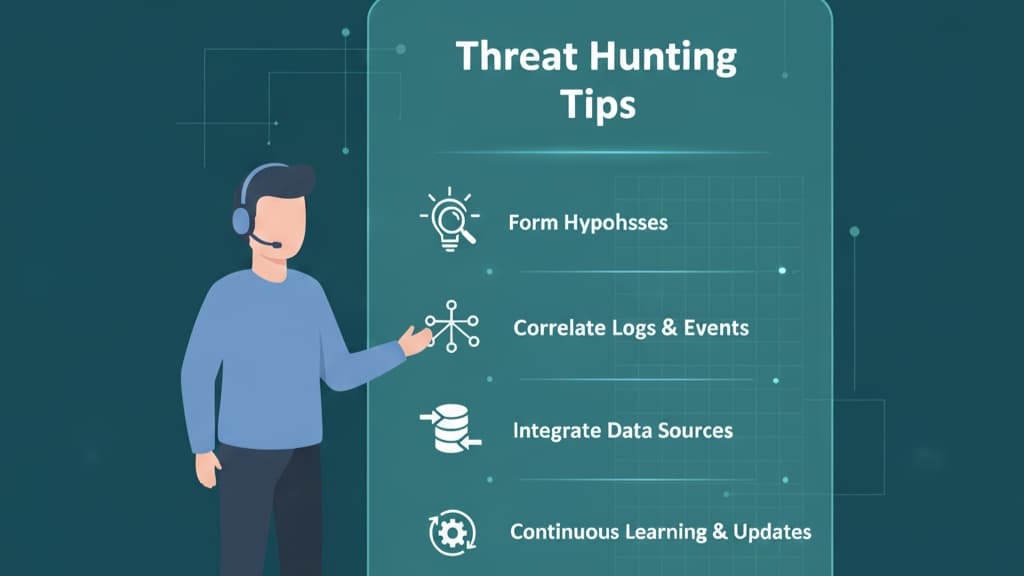
From our experience, a few best practices stand out:
- Form Clear Hypotheses: Start each hunt with a testable assumption based on intelligence and environment context.
- Leverage Diverse Data Sources: Combine endpoint, network, cloud, and user behavior data for comprehensive coverage.
- Automate Where It Helps: Use AI and machine learning to prioritize findings but keep human analysts in the loop for critical judgment calls.
- Document Thoroughly: Maintain detailed reports to inform future hunts and strengthen organizational knowledge.
- Adapt Continuously: Update detection strategies regularly to reflect new attacker techniques and client business changes. [2]
FAQ
1. What makes MSSP threat hunting different from normal threat detection?
MSSP threat hunting goes beyond basic threat detection by looking for quiet cyber threat activity that tools may miss. Hunters review log analysis, behavioral analytics, and anomaly detection across the attack surface.
This hands-on approach helps spot an advanced persistent threat early. It gives users deeper insight into what is happening inside their network.
2. How can threat intelligence help me during the threat hunting process?
Threat intelligence helps you see patterns in security alerts, malware analysis, and intrusion detection. It guides the threat hunting process by showing what a threat actor might try next. With this, users can understand the threat landscape better and make smarter choices about threat mitigation and incident response before a cyber attack grows.
3. Why do SOC analysts use SIEM data for threat hunting?
SOC analysts use SIEM data because it gathers signals from endpoint detection, network monitoring, and cybersecurity monitoring in one place. With this view, they can spot threat hunting indicators, find odd behavior, and build hunting hypotheses. It supports forensic analysis and helps users identify attacks earlier in the threat hunting workflow.
4. What are common threat hunting challenges for small teams?
Small teams often struggle with too many security alerts, limited threat hunting automation, and a wide attack surface. They also face difficulty creating a threat hunting playbook or setting strong threat hunting methodologies. These gaps make it harder for users to run real-time threat hunting or track threat hunting KPIs in a clear way.
Conclusion
MSSP threat hunting is more than an added service, it’s a proactive mindset that shifts cybersecurity from reacting to anticipating attacks. With MSSP Security’s expertise and advanced hunting capabilities, organizations gain faster detection and a stronger defense against sophisticated threats.
Routine alerts can miss silent dangers, but threat hunting exposes hidden risks before they escalate.
Ready to strengthen your security strategy? Get expert guidance here: Join MSSP Security. With 15+ years of experience and 48K+ projects delivered, we help streamline tools, enhance visibility, and build a tech stack aligned with your goals.
References
- https://en.wikipedia.org/wiki/Threat_hunting
- https://www.okta.com/identity-101/threat-hunting/