

Look, security audits are a pain for MSSPs, we get it. Your clients trust you with their data, and auditors will poke holes in every process until they’re satisfied.
Most providers panic and throw together last-minute documentation, but that’s not gonna cut it. We’ve been in the trenches with MSSPs facing tough audits, and there’s a better way to handle this mess.
Want to stop dreading those audit seasons and satisfying auditor requirements MSSP ? Stick around.
Key Takeaways
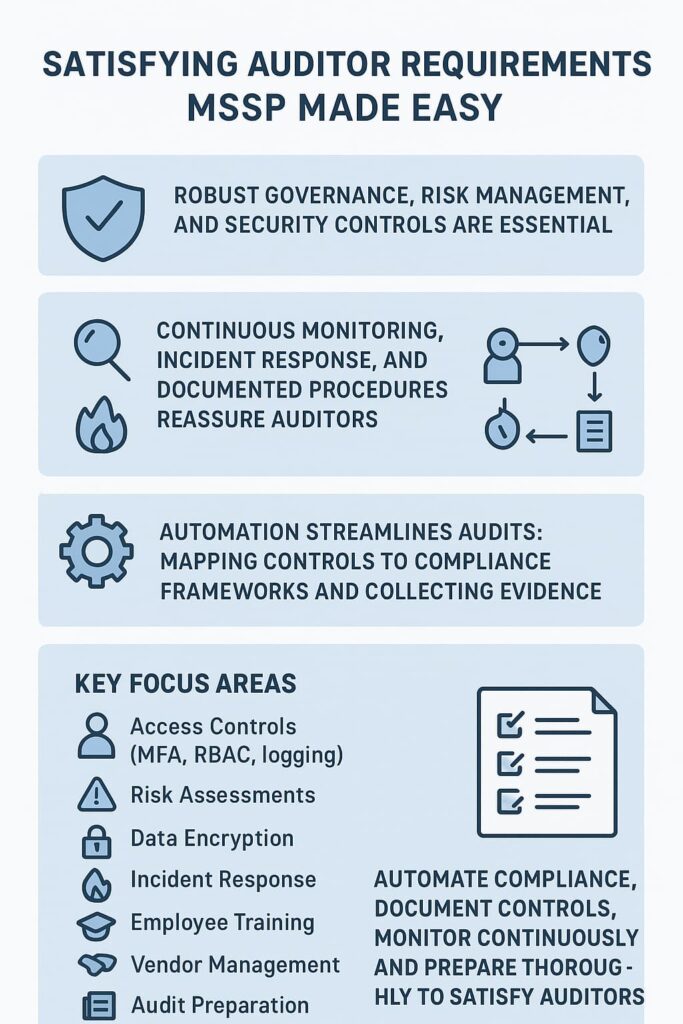
- Robust governance, risk management, and security controls are non-negotiable.
- Continuous monitoring, incident response, and documented procedures reassure auditors.
- Automation and clear documentation streamline audits and demonstrate compliance.
Understanding the Auditor’s Perspective

Security auditors aren’t trying to make life difficult, they’re paid skeptics with a mission. After watching hundreds of MSSP audits, we’ve noticed they care about one thing above all: solid proof that client data stays protected.
Fancy presentations won’t impress them much. Instead, they dig through governance docs, poke at risk controls, and cross-check if security measures actually work as claimed.
Most MSSPs trip up by showing perfect paperwork that doesn’t match reality. Having worked both sides of the fence, our team spots these disconnects before they become audit findings. The trick isn’t just knowing what auditors want, it’s building security that holds up under their microscope. [1]
What Auditors Look For: Key Areas of Focus
- Governance and Risk Management
Leadership can’t just talk about security, they need to walk the walk. We’ve seen auditors grill executives about risk decisions made months ago.
They check if management actually reads those risk reports, questions security choices, and puts money where it matters. Most MSSPs fail here because they treat governance like a checkbox exercise. - Security Controls and Implementation
Basic security measures need proof they work. Our assessments regularly catch MSSPs using default passwords, skipping encryption checks, or running outdated monitoring tools. Auditors spot these issues in minutes. They’ll dig into access logs, test encryption setups, and verify monitoring actually catches threats. - Compliance Documentation and Reporting
Sloppy paperwork sinks audits fast. Each policy needs clear ownership, regular updates, and proof it’s followed. After reviewing thousands of documents, we know auditors always check version history, looking for gaps between policy updates and staff training records.
Strong basic compliance reporting helps maintain documentation consistency and accuracy across audit cycles, reducing review friction and improving trust. - Continuous Monitoring and Incident Response
Fast threat detection means nothing without evidence. When auditors ask about that breach from last quarter, they want times, names, and documentation showing who did what and when. Our incident response reviews help MSSPs build audit-ready documentation before problems hit.
The Challenges MSSPs Face in Meeting Auditor Expectations

Meeting auditor demands isn’t always straightforward. MSSPs often navigate a complex regulatory environment, juggling multiple frameworks such as SOC 2, ISO 27001, HIPAA, GDPR, and PCI DSS.
We’ve faced challenges around resource constraints and expertise gaps that make continuous compliance difficult. On top of that, managing third-party vendor risks adds another layer of complexity.
Key Areas for Satisfying Auditor Requirements
1. Implementing Robust Access Controls and Identity Management
We’ve found that multi-factor authentication (MFA) is essential, not optional, to prevent unauthorized access. Defining clear roles through Role-Based Access Control (RBAC) and enforcing least privilege principles ensure users only access what they need. Finally, logging and monitoring user activity create audit trails that satisfy even the most stringent auditors.
2. Conducting Thorough Risk Assessments and Gap Analyses
Regularly assessing your environment to identify vulnerabilities and potential threats is foundational. It’s not enough to find gaps; you need to document the likelihood and potential impact, then develop prioritized remediation plans. Keeping detailed records of these assessments demonstrates proactivity to auditors.
3. Ensuring Data Encryption and Protection
Encrypting data both at rest and in transit is a baseline expectation. Managing encryption keys securely and implementing data loss prevention (DLP) tools add layers of protection. These measures reassure auditors that sensitive client data is guarded against unauthorized disclosure.
4. Establishing Comprehensive Incident Response and Reporting Procedures
Auditors expect MSSPs to not only detect incidents quickly but also document every phase: detection, containment, eradication, recovery, and reporting. Our experience shows that having detailed incident logs and clear escalation paths makes audits more straightforward and helps maintain client trust.
5. Automating Compliance Management and Reporting
Leveraging automation tools for mapping controls to compliance frameworks, collecting audit evidence, and generating compliance reports saves time and reduces human error. We use simplifying compliance reporting through automated processes to maintain real-time oversight and present auditors with up-to-date, accurate documentation.
6. Providing Ongoing Employee Training and Awareness
Regular training on compliance frameworks, evolving threats, and social engineering tactics is crucial. Auditors look for evidence that staff understand their roles in maintaining compliance and security hygiene. Our training programs are continuous and documented, reinforcing a culture of security.
7. Managing Vendor and Third-Party Risks
We pay close attention to the security posture of subcontractors and vendors. Rigorous due diligence, clear contractual security requirements, and ongoing monitoring ensure the entire supply chain meets compliance standards, a frequent auditor concern. [2]
Demonstrating Compliance to Auditors
Preparation is key. Gather your policies, procedures, risk assessments, monitoring logs, incident reports, and training records well before the audit. Conduct internal audits to identify and address weaknesses proactively. When auditors arrive, facilitate their work by providing clear documentation and being transparent about findings and remediation efforts.
Working collaboratively with external auditors, answering questions promptly and following up on findings, strengthens your compliance posture and client confidence. Modern automated compliance report generation ensures faster, evidence-backed responses when auditors request verification.
TL;DR: Key Actions for MSSPs to Satisfy Auditors
| Area | Action |
| Access Controls | Implement MFA, RBAC, least privilege, and user activity logging |
| Risk Assessments | Conduct regular assessments, document risks, and maintain remediation plans |
| Data Protection | Encrypt data at rest and in transit, manage keys securely, deploy DLP |
| Incident Response | Document detection, containment, eradication, recovery, and reporting |
| Compliance Automation | Use tools for control mapping, evidence collection, and reporting |
| Employee Training | Provide ongoing security and compliance education |
| Vendor Management | Perform due diligence, enforce contracts, and monitor third-party compliance |
| Audit Preparation | Organize documentation, conduct internal audits, and address findings proactively |
| Auditor Collaboration | Facilitate audits, provide requested evidence, and respond to audit findings promptly |
FAQ
1. How can MSSPs prepare for auditor reviews effectively?
Strong audit preparation starts with clear MSSP documentation requirements and consistent MSSP audit trails. Teams should maintain up-to-date MSSP risk assessment reports, security policies, and control assessments.
Regular MSSP internal audits help spot compliance gaps early, while maintaining detailed MSSP evidence collection ensures smoother managed security service provider audit cycles.
2. What frameworks guide MSSP compliance requirements?
Most MSSPs align with frameworks like ISO 27001, SOC 2, and PCI DSS. Meeting MSSP regulatory compliance involves mapping MSSP security controls to these standards.
Using MSSP compliance automation and MSSP control mapping helps maintain consistency, while regular MSSP governance practices support long-term compliance readiness across multiple frameworks and evolving regulations.
3. How does continuous monitoring help MSSPs meet compliance goals?
MSSP continuous monitoring plays a key role in satisfying auditor requirements. It tracks system performance, identifies anomalies, and supports MSSP incident response and vulnerability management. Strong MSSP audit logs, access control, and data protection policies all help maintain accountability.
Continuous oversight strengthens MSSP compliance monitoring and overall operational trust with auditors.
4. What kind of audit evidence do MSSPs need to collect?
MSSPs should document everything from MSSP incident documentation to risk assessment reports. Proper MSSP audit evidence includes screenshots, logs, reports, and MSSP training documentation that prove controls work as intended.
Maintaining complete MSSP audit workflows and using structured MSSP evidence management simplifies responses to auditor requests and shortens review time.
Conclusion
Satisfying auditor requirements is an ongoing journey, not a one-time event. By embedding strong governance, risk management, security controls, and automation into MSSP security practices, organizations like ours create a foundation for trust, compliance, and operational excellence.
With this approach, audits become opportunities to showcase your security maturity and commitment to protecting client data in an ever-evolving threat landscape.
Join us to streamline your MSSP operations, our expert consulting helps reduce tool sprawl, boost service quality, and align your tech stack with business goals. With 15+ years of experience and 48K+ projects completed, we deliver clear, actionable recommendations that strengthen your compliance and operational maturity.
References
- https://secureframe.com/blog/compliance-statistic
- https://sprinto.com/blog/compliance-statistics/