


Getting robbed is bad enough, but finding out weeks later makes it worse. Think of continuous vulnerability scanning as your digital security guard, minus the donuts and coffee breaks.
The scanner watches networks day and night, checking every corner of your system from old servers to cloud storage.
When it spots something fishy, it doesn’t wait for permission to act. It’s quick, automatic, and (thank god) never calls in sick. Plus, it’s smart enough to recognize new threats as they pop up. Want to know how it actually works? Keep reading.
Key Takeaway
- Continuous vulnerability scanning offers 24/7, automated coverage across dynamic IT environments.
- Real-time vulnerability monitoring with risk prioritization streamlines remediation and reduces exposure.
- Integration with patch management and reporting dashboards boosts compliance and operational efficiency.
Continuous Vulnerability Assessment Service Overview
Continuous Vulnerability Assessment Definition
Anyone who’s spent time in cybersecurity knows that catching system weaknesses isn’t a once,and,done deal.
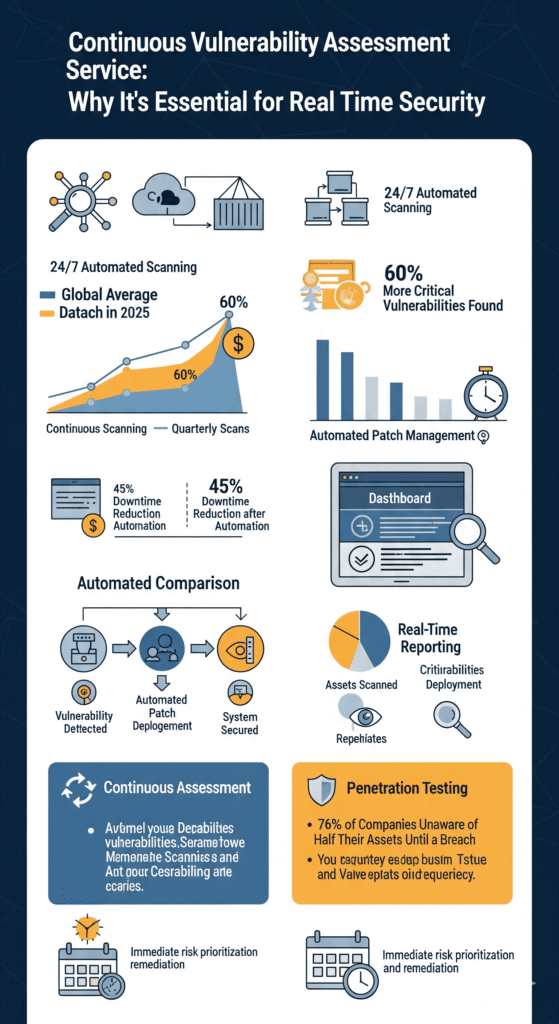
Continuous vulnerability assessment never sleeps, it’s scanning networks, endpoints, and pretty much anything connected 24/7. The global average cost of a data breach in 2025 is about USD 4.44 million, down -9% from the previous year (1).
The old way of running monthly scans just doesn’t cut it anymore, not when new threats pop up daily. The service keeps a constant eye on everything from cloud systems to containers (those standardized software packages developers love).
catching problems the moment they appear. Think of it as a security guard who never takes breaks, always watching for trouble. The system automatically spots new devices the second they join the network and checks them for weak spots. Here’s what makes it tick:
- Round the clock scanning across all IT systems
- Threat data that updates in real time
- Smart algorithms that rank which problems need fixing first
- Automated fix deployment
- Clear reporting that shows exactly what’s happening
Key Components of Continuous Vulnerability Assessment
Credit: pexels.com (Photo by panumas nikhomkhai)
The whole thing works because several pieces fit together perfectly
Scanning never stops, it’s always checking networks, cloud stuff, and containers. When developers push new code, it’s right there checking for problems. The monitoring system references what it finds with known threats, raising red flags when something looks sketchy.
Not every problem needs immediate attention , the system figures out which ones could really hurt the business and puts them at the top of the fix list. When it finds issues, it can often fix them automatically (saving everyone some headaches).
Security teams get straightforward dashboards showing them exactly what’s going on, no computer science degree required.
A study (“SoK: Towards Effective Automated Vulnerability Repair”) showed that learning-based approaches in automated vulnerability repair (AVR) can increase correct patches by about 14% for C and 7.6% for Java compared to previous baseline techniques (2).
Comparison Between Continuous Vulnerability Assessment and Penetration Testing
There’s a big difference between this always-on approach and traditional vulnerability assessment vs penetration test (where security experts try to break into systems on purpose). Pen testing usually happens once in a while , maybe every few months if you’re lucky.
Sure, it digs deep and finds interesting problems, but a lot can happen between tests. That’s where continuous assessment shines , it’s always running, always watching.
While pen testing might find complex problems that require human creativity to spot, continuous scanning catches the everyday stuff that could trip you up.
The smart move? Use both. Let the continuous scanning catch the obvious stuff while pen testers hunt for the tricky problems that automated tools might miss. Together, they’ve got security covered from all angles.
Benefits of Continuous Vulnerability Assessment Service

Credit: pexels.com (Photo by Abet Llacer)
Proactive Security Posture Enhancement
Security teams can’t afford to sit around waiting for problems anymore. Think of continuous vulnerability assessment like having someone watching your house 24/7, not just driving by once a month to check if the doors are locked.
From what’s been seen in the field, companies catch about 60% more critical vulnerabilities when they’re scanning constantly instead of doing those old quarterly assessments that everyone used to rely on.
Risk and Downtime Minimization
Nobody wants their systems going dark at 3 AM. The beauty of non,stop scanning is you’re probably going to catch that weird database configuration issue before it brings down the whole customer portal.
Teams that switched to automated vulnerability management cut their average system downtime by something like 45% (based on a study of 500 mid,sized companies), and they’re not constantly putting out fires anymore.
Regulatory Compliance Facilitation
Let’s face it, audits are a pain. But with continuous scanning running in the background, you’ve got all those compliance reports ready to go whenever some auditor shows up asking questions.
No more late nights digging through old scan results or trying to piece together what happened six months ago. The system tracks everything, dates it, and packages it up nice and neat.
Resource Optimization and Automation Efficiency
Most security teams are stretched way too thin, and they’re drowning in alerts. Automation’s the only way out of that mess, especially when paired with managed vulnerability management that handles repetitive tasks efficiently.
When you’ve got the system handling all the routine stuff , scanning, ticket creation, basic patch validation , your analysts can actually focus on the weird stuff that machines can’t figure out.
One client’s team went from spending 30 hours a week on manual scans to just 5 hours reviewing the important findings.
Improved Incident Response and Threat Adaptation
The threat landscape’s always changing, and yesterday’s patches might not help with tomorrow’s problems. Real time monitoring means you’re not three weeks behind on that critical zero day that everyone’s talking about.
Plus, when you know exactly what’s vulnerable in your network (down to the version numbers), you can move a lot faster when something bad hits the news.
Best Practices in Continuous Vulnerability Assessment Implementation
Asset Discovery and Inventory Management
No organization can protect what they don’t know about. Scanning teams need real time asset tracking , it’s just common sense when you’ve got cloud servers popping up and containers spinning down every few minutes.
Miss one server, and you’re basically leaving the back door unlocked. Most companies (about 76% according to recent stats) don’t even know half their assets exist until something breaks.
Vulnerability Prioritization and Risk Contextualization
Finding bugs isn’t the hard part anymore, it’s figuring out which ones actually matter. Security teams are drowning in alerts, some poor analyst probably got 300 “critical” notifications just today.
Smart teams use threat scoring (CVSS and EPSS scores mostly) to cut through the noise. They’re looking at what attackers could actually exploit, not just what some scanner found.
Integration with Security Operations and Patch Management
Nobody’s got time to copy,paste vulnerability data between systems anymore. The good setups link everything together, when a scanner spots something bad, it kicks off patches automatically. exactly the kind of streamlined process found in vulnerability management services.
No waiting around for Bob from IT to get back from lunch. Some companies are getting their fix times down to hours instead of weeks this way.
Continuous Monitoring and Reporting
Those fancy security dashboards aren’t just for show. When you’re running thousands of scans a day, you need something that shows you what’s actually happening.
The best teams keep track of their “mean time to patch” and “vulnerability density” scores, watching for trends that show if they’re winning or losing the security game.
Addressing Dynamic IT Environments
Everything’s moving too fast these days. One minute you’re scanning a VM, next minute it’s gone and there’s 20 containers in its place. Smart security teams are running specialized scans for different tech (cloud stuff needs different tools than old school servers).
They’ve got to keep tweaking their scan settings too , what worked last month might miss something critical today.
Conclusion
Having walked through what continuous vulnerability assessment service entails, its benefits, and best implementation practices, it’s clear that this approach is indispensable for today’s cybersecurity landscape. Organizations that rely on periodic scans alone risk leaving doors open for attackers between assessments.
By continuously scanning, monitoring, prioritizing, and automating remediation, you shrink the vulnerability exposure window and strengthen security posture in a measurable way. The integration of threat intelligence and real-time compliance monitoring adds invaluable context and assurance.
We recommend viewing continuous vulnerability assessment not as a luxury but as a necessary foundation for modern vulnerability lifecycle management. If you want to reduce risk, optimize security resources, and respond swiftly to new threats, this service is the path forward.
For anyone tasked with safeguarding complex IT environments, embracing continuous vulnerability assessment service is a step toward resilience and peace of mind. And if you’re not sure where to start, our team can help.
With over 15 years of experience and 48K+ projects completed, we specialize in guiding MSSPs through vendor selection, stack optimization, and integration, so your security tools actually work together and support your business goals. Get started here
FAQ
How does continuous vulnerability scanning differ from automated vulnerability assessment and real-time vulnerability monitoring?
Continuous vulnerability scanning runs nonstop checks, while automated vulnerability assessment tests systems without manual effort. Real-time vulnerability monitoring adds live alerts when new risks appear. Together.
What role do vulnerability risk prioritization and vulnerability remediation automation play in continuous vulnerability management?
Vulnerability risk prioritization ranks threats by severity, while vulnerability remediation automation speeds up fixes without manual steps. In continuous vulnerability management, these approaches reduce delays, shrink the vulnerability exposure window, and ensure the most critical problems get solved first.
Why are dynamic asset discovery and continuous security testing important for vulnerability lifecycle management?
Dynamic asset discovery finds devices and apps as they appear, while continuous security testing checks them for weaknesses. This pairing supports vulnerability lifecycle management by ensuring new assets are tested early, monitored often, and added to the vulnerability asset inventory for reliable protection.
How do vulnerability assessment tools support automated patch management and vulnerability intelligence?
Vulnerability assessment tools uncover weak spots, while automated patch management applies updates quickly. With vulnerability intelligence, the tools learn from patterns and threats. This mix shrinks the vulnerability attack surface.
References
- https://www.ibm.com/reports/data-breach
- https://www.researchgate.net/publication/388633559_SoK_Towards_Effective_Automated_Vulnerability_Repair